Flooded Neoclassical Ruins Cinematic Prompt
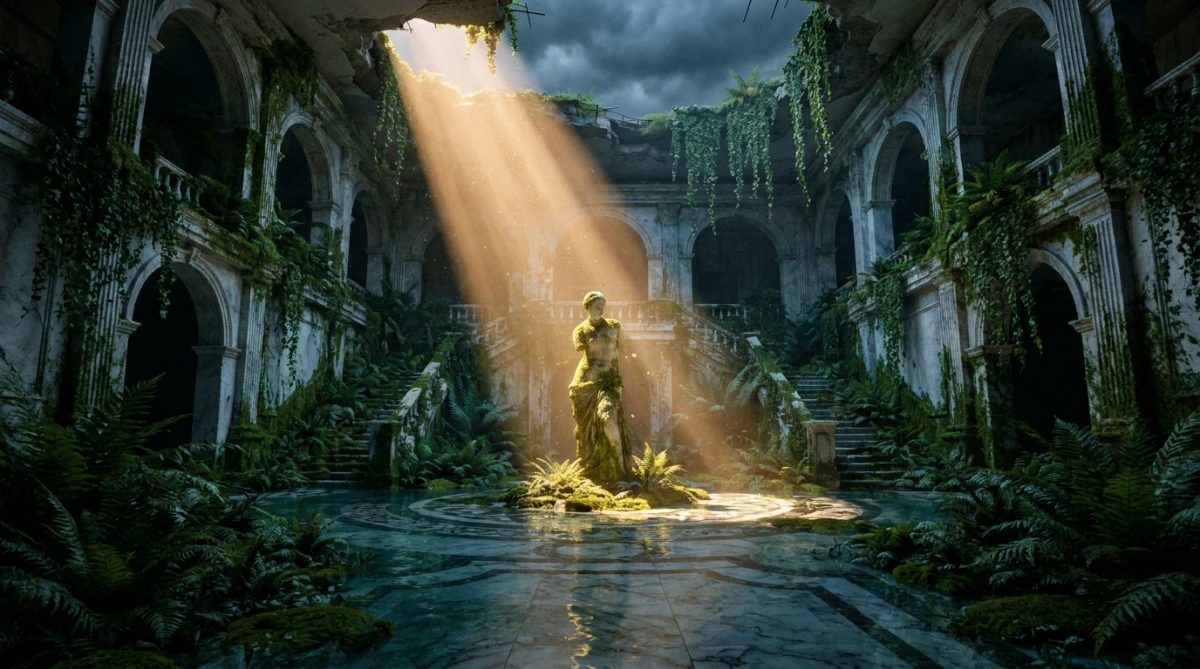
A cinematic wide shot of a ruined neoclassical museum interior flooded with crystal-clear water, reclaimed by nature, with a dramatic god ray illuminating a marble statue.
Prompt Body
[SUBJECT & ACTION]: A breathtaking, deeply melancholic wide shot of a ruined, grand neoclassical museum interior that has been entirely reclaimed by nature over decades.
[COMPOSITION & ENVIRONMENT]: The ornate marble floors are completely submerged in crystal-clear water. Massive, overgrown ancient ferns, hanging ivy, and thick moss cover the crumbling statues and grand staircases. The ceiling has caved in, revealing a dark, stormy sky above.
[LIGHTING & OPTICS]: Shot on ARRI Alexa 65 with a $24\text{ mm}$ wide lens at $f/4.0$ for rich, sweeping depth. A highly dramatic, single source of motivated light: a powerful, thick volumetric pillar of warm golden sunlight (god ray) breaks through the hole in the ceiling, illuminating a single, moss-covered marble statue in the center of the flooded room.
[COLOR & ATMOSPHERE]: A beautiful complementary palette of lush, vibrant forest greens clashing with the warm, glowing amber sunlight and the cold, damp blue shadows of the ruins. Millions of dust motes and floating plant spores dance in the sunbeam. Serene, heartbreakingly beautiful, and deeply cinematic, with soft organic film grain
Rate this prompt:
Guide & Practical Tips
How to use this prompt
This prompt is designed for Nano Banana (Gemini Flash Image) to create a high-quality cinematic still. Copy the full prompt text into the image generation interface. Adjust the lighting intensity or color palette if needed, but keep the core elements – ruined neoclassical architecture, flooded floor, nature overgrowth, and a single god ray – for best results. For Nano Banana, use structured sections as shown; the model responds well to clear subject, scene, lighting, and color descriptions.
Best use cases
- Concept art for a post-apocalyptic or fantasy story
- Book cover for a novel blending nature and ruin
- Editorial visual for articles on climate change, abandonment, or beauty in decay
- Cinematic still for mood boards or film references
- Poster or print with a melancholic, atmospheric theme
What to adjust
- Subject: Replace the moss-covered statue with a different focal point (e.g., a broken fountain, a fallen chandelier).
- Lighting: Change the god ray color from warm amber to cold blue for a more eerie mood.
- Environment: Add or remove specific plants (ferns, ivy, moss) or debris.
- Weather: Swap the stormy sky for a clear twilight or moonlight.
- Composition: Try a tighter shot or a different camera angle (low angle, top-down).
- Model: If using a different model, simplify the prompt structure; for GPT Image, use natural sentences.
Common mistakes
- Overloading the scene: Too many distinct elements can confuse the AI. Stick to one main statue or focal point.
- Ignoring lighting: Without specifying the motivated god ray, the image may become flat or muddy.
- Using abstract emotions: Instead of saying "melancholic," describe the visual cues (dark shadows, broken columns, still water).
- Contradictory instructions: Avoid mixing wide shot with close-up details unless clearly separated.
Variations
- Night version: Replace the god ray with moonlight, add bioluminescent moss, and deepen shadows.
- Minimal version: Focus only on a single fern growing from a cracked marble floor with soft light.
- Color shift: Change the palette to teal and orange for a blockbuster cinematic look.
- Time of day: Golden hour god ray with longer shadows.
- Character inclusion: Add a lone figure in a hooded cloak standing on a submerged step.
You might also like

Sci-Fi Horror: Tentacle God in Derelict Hall
GPT Image 2
Avant-Garde Extraterrestrial Portrait with Crystal Headpiece
GPT Image 2
Underground Bare-Knuckle Fight AI Prompt
Nano Banana
Laika-Style Stop-Motion Scrapyard Diorama
Nano Banana
Art Deco Cabaret Statue – Cinematic AI Prompt
Nano Banana
Lone Rider in Amber Apocalypse
Nano Banana
Post-Apocalyptic Neon Hideout Cinematic Prompt
GPT Image 2