Beksiński Surreal Seascape AI Prompt
A text-to-image prompt for GPT Image 2 inspired by Zdzisław Beksiński's dark surrealism, featuring a faceless figure at a stone table under a stormy sky, with a luminous die and thick oil-painting texture.
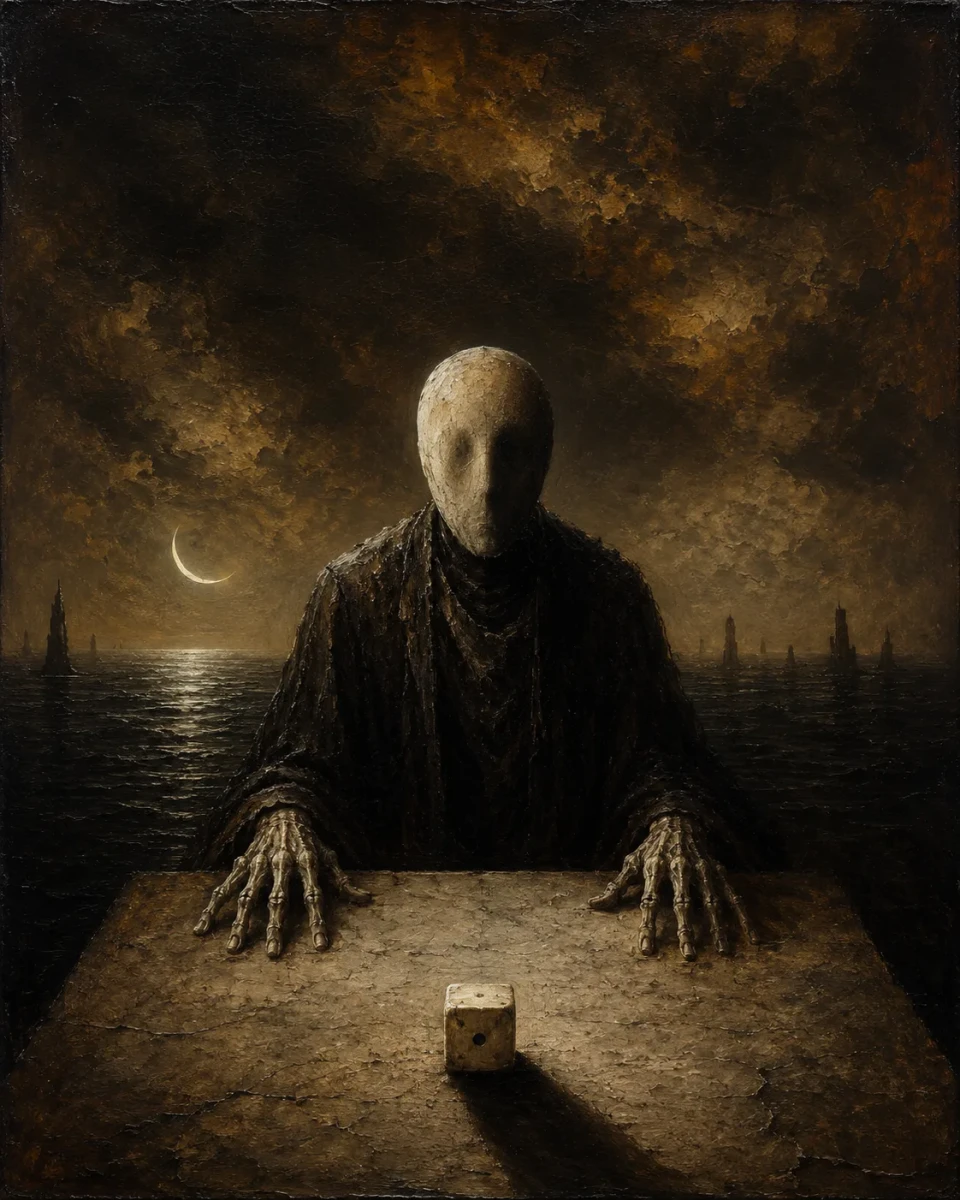
An oil painting on aged canvas in the style of Beksiński and metaphysical surrealism.

SCENE: a desolate dark seascape at night, turbulent storm clouds churning across the sky in muted amber, ochre and burnt-sienna tones, a thin glowing crescent moon low on the horizon casting cold pale light across black water. Heavy atmospheric haze, deep aerial perspective.

SUBJECT: a faceless humanoid figure seated at a weathered stone table, centered. Pale ovoid head, smooth and eggshell-like with subtle shadowed indentations where features should be, no eyes, no mouth. Draped in dark tattered clothing that dissolves into the shadows of the lower frame. Oversized skeletal hands with elongated bony fingers resting flat on the pale tabletop, knuckles catching the moonlight.

KEY DETAILS: a single small cubic die in the foreground, sharply rendered, faintly luminous, showing the face "one", casting a long hard shadow toward the figure. Dust motes suspended in the moonbeam.

LIGHTING: single cold rim light from upper-left rear, rim-lighting the skull and finger bones, warm amber ambient fill fading into near-black. Strong chiaroscuro, low-key.

COMPOSITION: centered, symmetrical, the die anchoring the lower third, vast empty sky above creating dread.

TEXTURE: visible oil brushstrokes, thick impasto highlights on the bones, fine craquelure across the canvas, matte varnish, earthy brown and black palette. No digital smoothing, no clean gradients.

Mood: macabre, silent, fatalistic.
Guide & Practical Tips
How to use this prompt
Copy the entire prompt into GPT Image 2 (ChatGPT). The model will interpret the natural language description of the scene, figure, lighting, and texture. Keep the core visual elements fixed: the faceless figure, stone table, die, stormy sky, and oil-painting style. You can adjust the color palette by modifying the "amber, ochre and burnt-sienna" to other earth tones. For best results, avoid adding extra subjects or changing the composition symmetry.
Best use cases
This prompt is ideal for creating album covers, dark fantasy book covers, gothic poetry illustrations, or atmospheric art prints. It also works well as a concept art piece for a surrealist game or film mood board.
What to adjust
- Subject details: Change the die to another object (e.g., a chess piece, a candle) to shift symbolism.
- Color palette: Swap earth tones for cooler blues or warmer reds to change mood.
- Lighting: Increase rim light intensity or add a second light source from below.
- Texture: Reduce craquelure for a smoother canvas, or add more visible brushstrokes.
- Aspect ratio: Use 4:5 for print, 16:9 for digital wallpaper.
Common mistakes
- Adding facial features to the figure – the prompt relies on facelessness for surreal effect.
- Overcrowding the scene – keep minimal; the die and figure are enough.
- Using digital smoothing – the prompt specifies no digital smoothing; avoid terms like "8k" or "ultra detailed".
- Ignoring the atmospheric haze – it adds depth and dread.
Variations
- Nocturnal seascape: Replace the figure with a solitary lighthouse in the distance.
- Vanitas still life: Focus on the die and a skull, removing the figure.
- Warmer palette: Use deep reds and gold for a more dramatic, hellish atmosphere.
- Cinematic version: Change aspect ratio to 21:9 and add anamorphic lens flare.
You might also like
Sultry 1970s Pool Hall Film Still
GPT Image 2
Dark Romantic Top-Down Portrait
Nano Banana
Opulent Baroque Perfume Still Life Prompt
GPT Image 2
Dark Fantasy Knight with Neon Halo
GPT Image 2
Avant-Garde Extraterrestrial Portrait with Crystal Headpiece
GPT Image 2
Gothic Cathedral Volumetric Light Prompt
GPT Image 2
Cyberpunk Cyborg Eye Close-Up
GPT Image 2