F1 Night Circuit Racing – Ultra-Wide Motion Blur Prompt
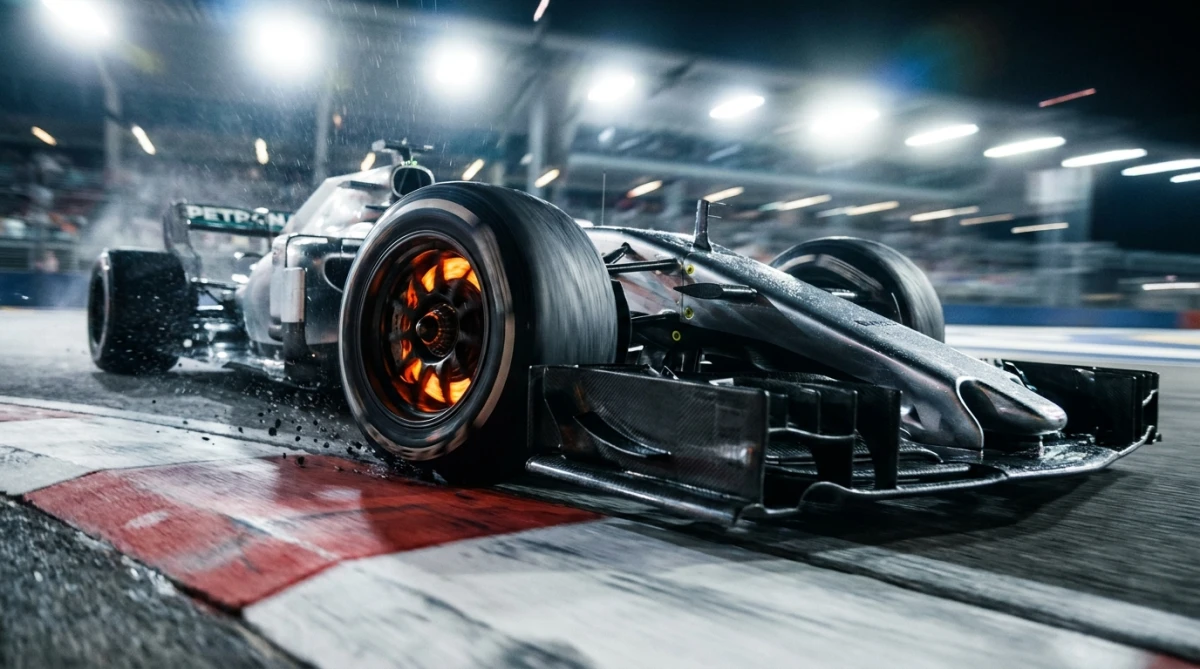
An extreme low-angle shot of an F1 car clipping a chicane at night, captured with an ultra-wide lens and glowing brakes. Ideal for racing, cinematic, and action visuals.
Prompt Body
[SUBJECT & ACTION]: An extreme low-angle ground-level shot from the apex kerb of a tight chicane on a night street circuit. An F1 car is aggressively clipping the red-and-white curb, mid-turn.
[COMPOSITION & GEOMETRY]: The front-left wheel of the car is massive in the immediate foreground, showing extreme tire deformation and rubber texture under heavy cornering loads. Behind the wheel, the carbon-fiber front wing is sharp and detailed, while the rest of the car's body and the background are swept into a radial, violent motion blur.
[LIGHTING & OPTICS]: Shot on RED V-Raptor with a 15mm ultra-wide lens at f/4.0. The massive carbon-ceramic brake discs inside the wheel glow with a searing, semi-translucent molten-orange heat. The scene is illuminated by harsh, overhead stadium floodlights, creating stark specular highlights on the wet, shiny carbon fiber nose of the car.
[COLOR & ATMOSPHERE]: Raw, cold industrial color palette. High-contrast deep shadows on the asphalt and brilliant, overexposed white and yellow light from the track-side projectors. Tiny rubber marbles (debris) are kicked up by the tire, suspended in the air near the lens. Subtle lens flare, fine film grain, and an overwhelming sense of speed and mechanical violence --ar 16:9
Rate this prompt:
Guide & Practical Tips
How to use this prompt
This prompt is designed for the Nano Banana model. Copy the exact prompt text into the Nano Banana interface, keeping the structured sections. The model will interpret the scene description, lighting, and camera specifications to generate a high-contrast, motion-blurred racing image. For best results, ensure the aspect ratio is set to 16:9 and avoid adding extra technical filler.
Best use cases
- Racing game concept art: Create promotional stills for motorsport games.
- Advertising creatives: Use as a dynamic background for car or tire ads.
- Social media visuals: Post as a dramatic cover image for motorsport content (16:9 or 4:5).
- Editorial layouts: Accompany articles on F1 racing or automotive engineering.
- Website hero: A high-impact hero image for a racing team or automotive brand.
What to adjust
- Car model: Change the subject to another vehicle (e.g., motorcycle, rally car) by updating the description.
- Track environment: Replace the night street circuit with a rain-soaked track, desert road, or city tunnel.
- Lighting: Swap stadium floodlights for neon signs or practical lights to change mood.
- Shutter speed effect: Increase or decrease motion blur intensity by modifying the description (e.g., “sharper frozen motion” vs. “more intense radial blur”).
- Color palette: Shift from cold industrial to warm sunset tones by adjusting the color section.
Common mistakes
- Overuse of motion blur: Too much blur can hide the car’s details – balance with sharp foreground elements.
- Ignoring the aspect ratio: Nano Banana works best when the aspect ratio is explicitly set (always include --ar 16:9).
- Conflicting camera specs: Avoid mixing ultra-wide with telephoto descriptions – stick to the given 15mm lens.
- Missing heat effect: The glowing brakes are key – if omitted, the image loses its dramatic focal point.
Variations
- Rain-soaked track: Add “puddles reflecting the floodlights” and “spray from the tires.”
- Daytime version: Remove night lighting and use harsh sunlight with dust particles.
- Top-down tire view: Change the angle to a direct overhead shot of the wheel scuffing the curb.
- Vintage formula car: Switch to a 1970s F1 car with retro livery and softer lighting.
- Minimalist version: Isolate the front wheel on a black background with only the brake glow.
You might also like
Underground Bare-Knuckle Fight AI Prompt
Nano Banana
Raw Boxing Portrait – Gritty Cinematic AI Prompt
Nano Banana
Gritty Soccer Slide Tackle in Rain
Nano Banana
Fierce Cossack-Viking Chief in Storm
GPT Image 2
Fierce Female Samurai in Gritty Battle Scene
GPT Image 2
Underground Bare-Knuckle Fight Prompt
GPT Image 2
Retro Superhero Panning Shot Prompt
GPT Image 2